
Musings: Writing Is Easy. Editing Is Hard.
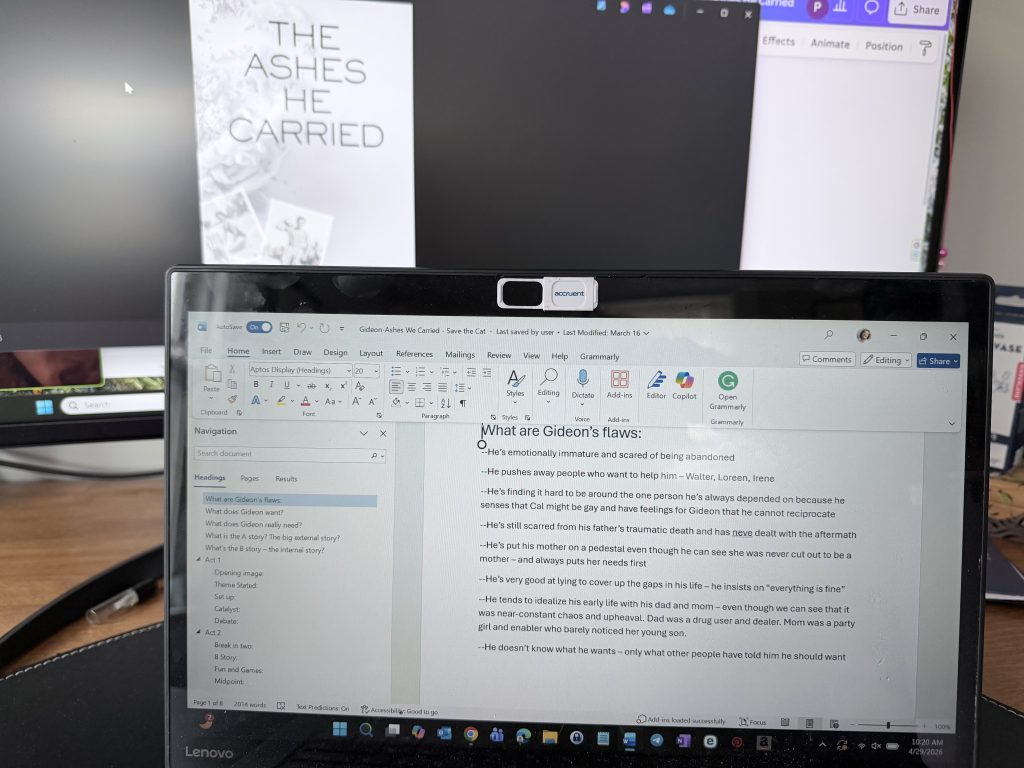
I finished my first novel, The Ashes He Carried.
Well… it’s finished-ish.
I wrote the whole thing. The words poured out. I could hear my main character’s voice, feel his ache, and follow him all the way to his hard-won happy ending. I felt like I spent time with the characters and was really in the room where it happened.
And then came editing. That’s when things got ugly. You step back and realize your beautiful book is 500-plus pages long and could double as a doorstop.
Writers love to quote, “Kill your darlings.” Faulkner usually gets credit, though Sir Arthur Quiller-Couch got there first. Whoever said it first doesn’t really matter.
What matters is this: when you are writing, every word feels brilliant. Every scene feels necessary. Every side character seems to deserve their own limited series.
So now you edit.
If you cut this scene, does something stop making sense 100 pages later? If you get rid of a minor character, do you leave a plot hole behind? Editing can feel like starting with a 1,000-piece puzzle of a lighthouse and ending up with a 500-piece puzzle of… puppies. Cute, maybe. But not the picture on the box.
At least that’s what it feels like in the squishy middle of editing.
The good news is that editing really does make the story stronger.
My book still has the same redemption arc it had when it started. It just has fewer scenic detours, fewer extra side roads, and fewer people wandering in and script approval.
My minor characters tried very hard to seduce me with their importance. What about the tired social worker trying to help? What about all the townspeople making my main character miserable? In the end, most of them had to go. One stayed. The others got a polite little shove offstage.
That’s the difference between writing and editing.
Writing is loose and free. You get an idea and run with it. You listen to your characters. You chase the energy.
Editing is different. Editing is structure. Editing is restraint. Editing is about making sure the whole thing holds together without collapsing in the middle.
And if you are a delicate sort of writer, you may want to stop reading now.
Because yes, I used AI. Cue the handwringing.
AI did not write my book. Not one sentence. That part was all me. But AI did help me edit it, and honestly, it was ridiculously useful.
It helped me find dropped story threads. It flagged confusing spots. It pointed out places where I had made a mess of something important, like the distinction between an estate and a trust, which matters quite a bit.
It also helped with the less glamorous stuff. Inconsistent spelling. Titles. Timeline issues. Grammar that went a little sideways. Storylines I quietly dropped for 150 pages and then picked back up at the end, like no one would notice.
Sometimes cheerfully snarky. But helpful.
It also saved me from digging through a mountain of pages every time I needed to find one tiny earlier detail. If I needed to reference something from somewhere near the beginning while revising page 246, AI could point me to it fast. That meant I could stay accurate without drowning in Post-it notes and spreadsheets.
And yes, I know some people are still deeply suspicious of AI.
Fine. Be suspicious.
But in this case, AI was not the author. It was the assistant. A very efficient, slightly annoying, relentlessly cheerful assistant who never got tired of rereading (again and again), never huffed dramatically, and never once said, “Didn’t we already fix this?”
That alone may be worth the price of admission.
By the time I was done, my editing made the book tighter, cleaner, and much easier to follow. The story moved faster. The good guy got where he was going with fewer distractions. And if I eventually hand it off to a human editor, they can focus on the story itself instead of wondering why one poor character’s name has four different spellings.
Would I have found these problems on my own?
Probably.
Eventually.
Maybe.
But the book is still nearly 79,000 words. That is a lot to hold in your head at one time. A lot of moving parts. A lot of promises made early to the reader that need to pay off later.
So no, AI will not replace me as a writer. Not even close.
The fun part, the strange part, the part where characters surprise me and scenes suddenly deepen and something unexpected becomes moving instead of ordinary—that’s still mine. AI could not have written this book. It could not have found the heart of it. It could not have created the moments that made me care.
But when it came to editing, organizing, checking, and clarifying? AI was exactly the sidekick I needed.
I’m still the main character.
AI is just the supporting cast.
Which is good.
I’m not at all sure what AI would wear to a book award ceremony.