
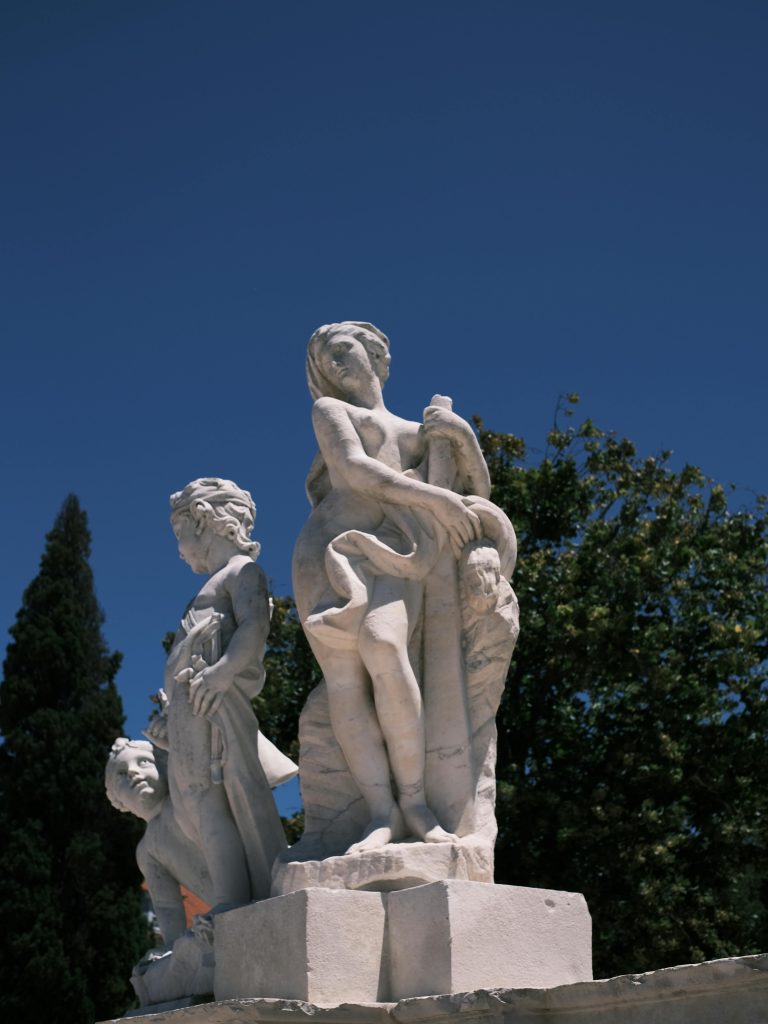
Musings: Why Are Statues of Women Usually Naked?
You’re out sightseeing. A man in full battle regalia, or at least a respectable-looking suit, stands in the middle of a park commemorating something important. A few yards away, in the nearest fountain, two naked or mostly naked women are draped over an urn.
Why do male statues usually get to wear the pants?
Yes, yes, I know. There are statues of fully clothed women all over the world. Some even have names. Wonderful. Love that for us.
What I am saying is this: there seems to be a pattern.
Men in statues are often specific people. Leaders. Warriors. Scientists. Statesmen. They are identified on plaques. Their achievements are listed in solemn bronze.
Women in statues are very often something else entirely. They are symbols. Virtues. Muses. Nymphs. Maidens. Justice. Liberty. Grief. Spring. Dawn. Decorative sorrow with one shoulder exposed. Or wearing even less.
Am I oversimplifying? Of course.
But I am also pointing out something you may not have noticed until now. Once you see it, you cannot unsee it.
Walk through a museum or public garden and look around.
Men are doing things.
Women represent things.
Men are remembered for what they accomplished.
Women are often there to soften the edges, add beauty, or gaze upward from the base of somebody else’s monument.
What I’m saying is that even when women are present, they are often not the subject. They are the garnish. The adoring acolyte.
And before anyone says these statues commemorate important men doing important things, yes. Some of them did.
But let’s talk for a minute about what made some of those important things possible.
Take Thoreau at Walden Pond.
He gets remembered as the rugged thinker, quietly contemplating the meaning of life by the lake. Lovely image. Very man-alone-with-his-thoughts. But while Henry was off simplifying, his mother and sisters were doing the laundry and sending him home from Sunday dinner with doggie bags of leftovers for the week.
Let that sit a minute.
I do sometimes wonder how much deep thinking would have happened if he had to spend Thursday hauling water, scrubbing shirts, Wednesday baking bread, and Friday shopping for food, and figuring out what was for supper.
Yes, I know he grew vegetables. Yes, I know he worked. That is not the point.
The point is that many men who became “great” had help. A lot of help. Quiet help. Unpaid help. Uncredited help. Women. Enslaved people. Servants. Workers. Family members.
They created the space that allowed greatness to bloom. And then history gave the statue to the man in the coat.
To be clear, I am not arguing that Lincoln, Washington, or other major historical figures should not have statues. Many of them changed history. What I am saying is that maybe the people who made their lives possible deserve a little bronze, too.
Mary Todd Lincoln comes to mind. Abraham Lincoln did not become Abraham Lincoln all by himself. Mary brought family connections, money, political instinct, and relentless social schmoozing to the table. Yet he gets the monument, and she mostly gets remembered as difficult or crazy.
Funny how that works.
Maybe it is time to widen the frame.
Maybe it is time to ask not just who stood at the podium, led the troops, or signed the document, but who cooked the meals, ran the household, managed the relationships, stitched the clothes, raised the children, and kept life moving while history was being made.
Those stories matter, too. So let’s tell them.
And maybe let’s erect a few more statues while we are at it. Clothed ones. Named ones.
Statues of the women, the workers, the enslaved people, the forgotten enablers, and the people whose labor made somebody else’s greatness possible.
After all, someone had to wash and mend George Washington’s pants.